Every year, Startup Genome releases its Global Startup Ecosystem Report, the most comprehensive benchmark of startup activity on the planet, pulling from over 5 million companies across 350+ ecosystems worldwide.
The 2025 edition landed with a clear message: the game has changed, and the founders who understand exactly how are the ones positioned to win. We pulled the most important insights from this year's report. Specifically, the ones that matter most to the kind of people who use BuildBnB: founders raising capital, developers choosing where relocate, and early-stage entrepreneurs figuring out how to get in the room.
Here's what the data is telling us.
The Market Is Tighter… and That's Actually Great
Let's not sugarcoat it. The global startup economy is in the middle of a significant correction. Across the top 20 ecosystems, the median drop in Ecosystem Value (a measure of funded startup valuations and exits) was 24% in 2025, with an aggregate global decline of 31%. Early-stage funding (Seed and Series A) has trended downward since its 2021 peak, and large exits (those over $50M) dropped 31% across the top 40 ecosystems. Though, this is not a collapse. The 2021 boom saw 682 new unicorns created… four times the rate of the two preceding years combined. Valuations got inflated fast, and the market is now finding its floor. For builders who didn't get caught up in that frenzy, this is actually a cleaner environment to build in.
There is one number from this year's report, though, that every early-stage founder needs to internalize. Roxanne Varza, Director of Station F (one of the world's premier startup campuses) put it plainly in the report:
"Some investors no longer want to talk to companies unless they are making $1 million in revenue within the first six months."
Read that again. Six months. $1 million. That's not the bar for raising a Series A …. that's the bar for getting the first conversation! The era of "build it and they'll fund it" is over. Execution speed is now the entry fee.
Where You Build Still Matters… A Lot
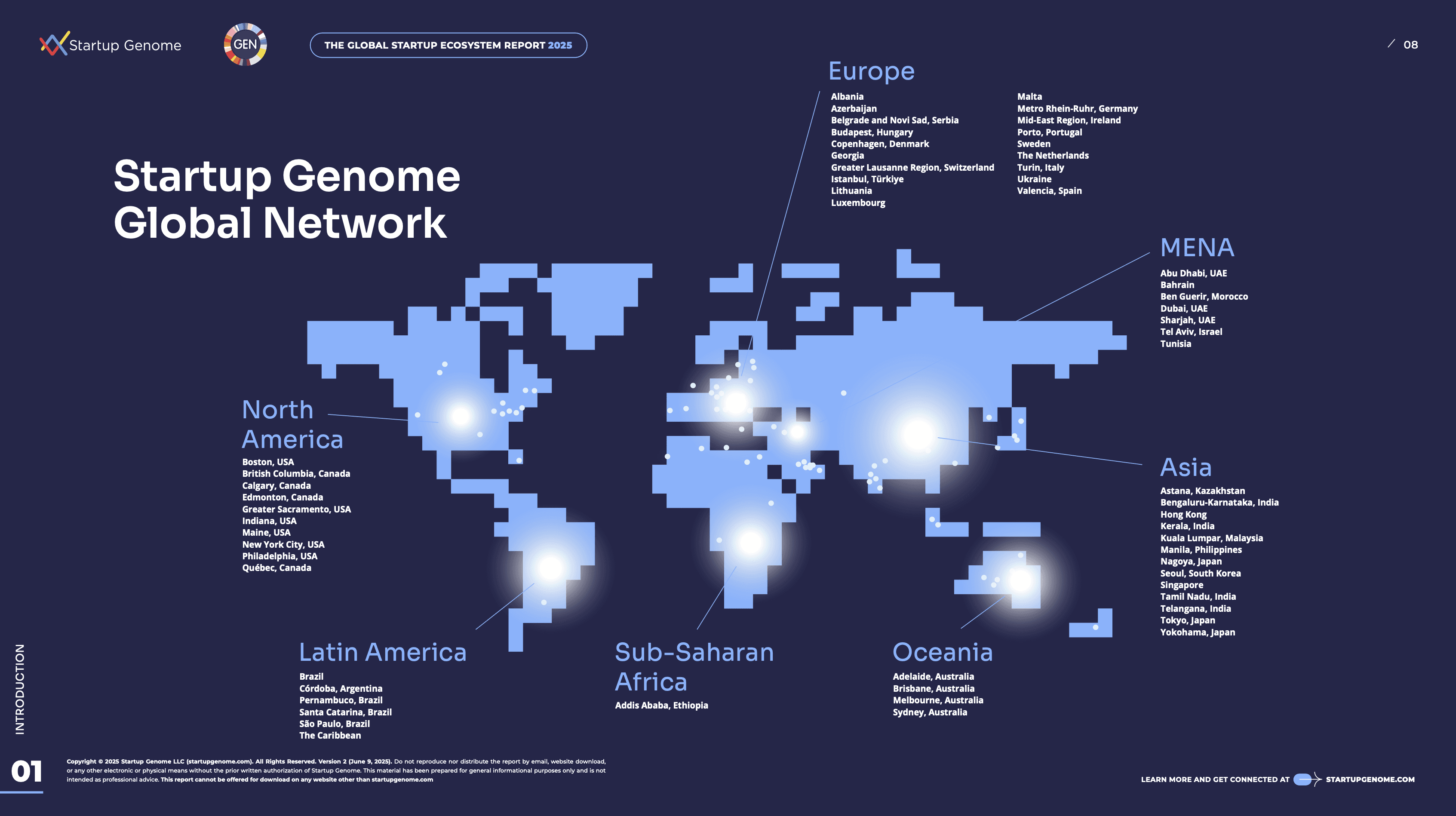
The report confirms something that the BuildBnb community already understands intuitively: geography is strategy. Where you physically show up during a critical phase of building has a direct effect on who funds you, who you meet, and how fast you move. The data backs this up across the board.
A few city-specific details from this year's report stand out.
New York City retained its position as the #2 global startup ecosystem. What's interesting for founders considering building in the city is that "Tech:NYC" (a major industry alliance) runs something called the Founder House, a program that brings 25 early-stage tech entrepreneurs together each quarter and directly connects them with investors and industry experts.
Silicon Valley remains #1 globally, drawing $90 billion in VC in 2024 alone which accounts for 57% of all U.S. startup investment that year. One detail worth noting for non-traditional founders: the report highlights that IBM, Google, GM, and Apple have all dropped degree requirements for tech roles, with Silicon Valley increasingly prioritizing skills over credentials. If you've been hesitant about showing up without a conventional background, that signal matters. Peter Thiel's $100,000 fellowship for non-traditional entrepreneurs reinforces the same point.
Shanghai is making a significant infrastructure bet as well. Construction began in February 2025 on what the report describes as the world's largest AI incubator, spanning over 100,000 square meters, with comprehensive support for AI startups. If AI is your lane and you haven't looked east, the window is opening fast.
Brazil is the most striking underdog story in this year's report. From 2020 to 2024, early-stage funding in the city of Recife grew 1,534%, driven largely by a $32 million venture round for medical software startup Amigo Tech. Anchored by the Porto Digital innovation district, a public-private initiative launched in 2000 that has grown from 2 companies to 475, Recife is proof that the next great startup city doesn't always look like what you'd expect.
The Macro Signal
Across every region, one theme dominates the 2025 report: AI is no longer a sector… it's the engine. VC funding into AI and Big Data startups grew 33% in the past year, making it the fastest-growing sector tracked in the report. It now receives 40% of all VC investment globally, up from 26% in 2021. Series A rounds for AI startups are, on average, nearly double the size of those in other sectors.
If you're building with AI, the capital is not going anywhere. If you're building without it, you're competing for a shrinking share of attention.
What This Means for How You Build
The picture that emerges from the 2025 GSER is one that favors founders who are physically present in the right places, moving fast, and building real revenue early. The infrastructure exists (in NYC, in Silicon Valley, in Shanghai, and in unexpected places like Recife) but you have to actually show up to access it.
That's the whole premise behind BuildBnB. The founders who are winning right now aren't just building in isolation… they're relocating for sprints, embedding themselves and their solutions in ecosystems, and using proximity as a competitive advantage. Whether it's a few weeks in a city to close a funding round, a month testing product-market fit in a new market, or simply being in the room where the right conversations happen… the short-term stay isn't a travel decision…. It's a strategic one.
The data says so. The ecosystem stories in this year's report say so. Now it's about acting on it.
*Source: Global Startup Ecosystem Report 2025, Startup Genome LLC in partnership with the Global Entrepreneurship Network. All statistics cited from the 2025 edition. LINK